


Chuck Gould lost 95% of the apples, peaches and other produce beginning to bud on his Monroe County farm during an unexpected frost that lasted from April 19 to 21.
"Just all of the things that we have to prevent against freezing just don't work in those kinds of temperatures," he said.
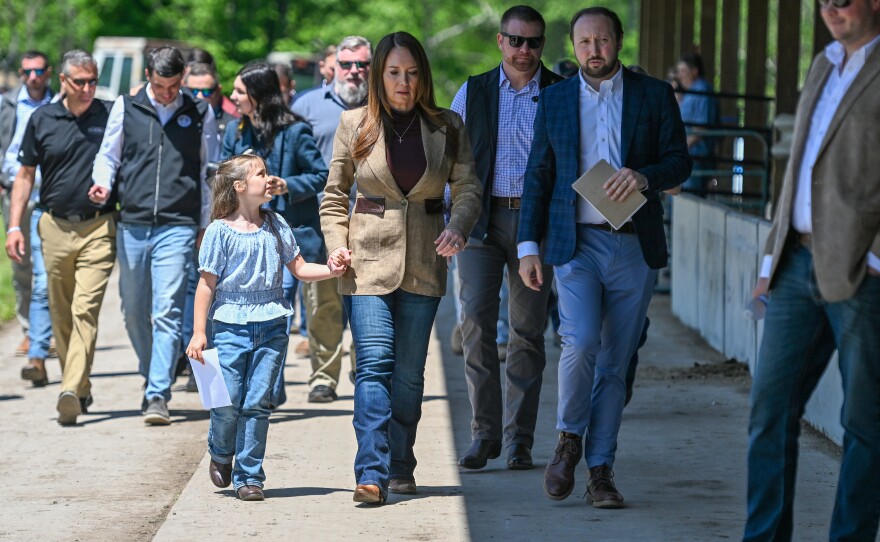
Gould joined a roundtable discussion with United States Secretary of Agriculture Secretary Brooke Rollins at the Nogan Family's Applewood Farm in Scott Twp. on Tuesday. The secretary stood in front of the farm's Angus beef cows and signed a disaster declaration for 17 counties in Pennsylvania to help farmers, like Gould, recover financially from the frost.

The declaration was requested by Pennsylvania Governor Josh Shapiro, who sent a letter to the USDA in early May. Eight U.S. Representatives from Pennsylvania also sent a letter on May 15.
The roundtable discussion was hosted by U.S. Rep. Rob Bresnahan and joined by farmers from the 8th congressional district, which the Republican congressman represents.
Rollins said Tuesday the extent of the damage from the frost is still being researched, but it's estimated that farmers in Pennsylvania lost $150 to $200 million in revenue from the cold weather.
The U.S. Farm Service Agency (FSA) can now provide emergency credit to producers.
"These loans can meet various needs of recovery, including the replacement of essential items, such as equipment or livestock, reorganization of a farming operation, or to refinance certain debts," Rollins said.
For farmers who already have loans with the FSA, the declaration will allow them to defer one payment.
Farmers in the 17 counties and in some neighboring states have until January to apply for the loans. Rollins said more counties will be added to the declaration as the department continues to review disaster designations and data.
"The aftermath of this freeze event will impact businesses across the entire supply chain. We can't control the weather, but we can control how we respond," Rollins said.


'Farming isn't easy'
Gould's Produce and Farm Market is a sixth-generation farm in Brodheadsville on 200 acres. About 20 acres are just for the stone fruit, Gould said.
Buds burst on the trees during a warm spell in April, he said. Then the cold weather came and froze the blossoms. Gould said they put thermometers around the farm in April. Some read 16 degrees.
"Nature …you have no choice but to deal with it," he said.
The family sells most of their produce at their farm store. This year, they'll have to find another source of apples.
"Farming isn't easy, you can do everything right and still get hammered in the end, but the worst day of farming I ever had was better than the best day I had any place else, except when I got married," Gould joked after the discussion.



Providing help
Shapiro and the U.S. representatives' letters requested that the USDA issue a Secretarial Disaster Designation and expedite disaster assistance for Pennsylvania farmers affected by the freeze. That request included faster damage assessments that will help growers begin filing crop insurance claims, according to the state.
The Pennsylvania Department of Agriculture is glad the USDA has stepped up to help farmers.
"We are looking forward to continuing conversations with the federal government to make sure all farmers impacted by the April freeze have access to resources and support," according to the agency.
According to the state, Shapiro asked the general assembly to devote $20 million in the 2026-27 budget to help fruit growers recover from devastating frost damage.
"The Shapiro Administration will continue to have the backs of our farmers and make sure we explore every option at our disposal to help them through this crisis," the state says.
Keeping farmers in business
Both Rollins and Bresnahan said the low-interest loans from the USDA could help farmers prepare for the next season.
Because, as Bresnahan put it, farmers have fixed costs that stay the same regardless of whether they produce or not.
"This is the difference between recovery and quite possibly shutting their doors. Our farmers are resilient, but they shouldn't have to carry this burden alone," he said.
That is Gould's experience. He said apple trees can produce for 50 years, peach trees, 25 years.
"You still have to continue to maintain the trees, though, because if you don't, they won't be healthy for next year, so you won't get much of a fruit set then either," he said.
A low-interest loan from the USDA could help Gould's family farm prepare its trees for next season.
"You know, tornado goes through and houses get destroyed, there's money available to rebuild. In a farming sense, this is the kind of year where you can get just absolutely hammered, and if you don't have the wherewithal to stand it or help to withstand it, you can go out of business," he said.

Data centers and more
David Nogen said it was a huge honor to host Rollins at their farm, which his family started in the 1980s.
"And see what not only we do but everybody in Northeastern Pennsylvania does, and how agriculture works in this part of the country," he said.
Press joined the roundtable near the end of the discussion. Rollins, who is from Texas, took a few last questions and reviewed what she and the farmers discussed.
Dan Naylor, the chair of the Lackawanna County Republican Party, asked Rollins what role artificial intelligence plays in the future for the USDA.

She first addressed protecting farmland from data centers.
"I realize we have to ensure that we keep it in check … the data centers, especially, we talk about protecting farm land, that's for me the biggest concern," she said.
Rollins called it a balancing act, and said that President Trump and his administration are "hyper focused" on making sure that China doesn't "out run" the United States when it comes to AI.
"But at the same time making sure that we're able to preserve and protect our farmers and ranchers, and I think this president and our administration is the right team to take that on," she said.
Rollins said her department needs to ensure that midsize and small farmers have access to some of the technology that larger farms use, including drones to monitor herd sizes and pests.
They also discussed supporting generational and new farmers, labor, liability protections for those who work in agritainment, the migrant workforce, the grant system for farms, land affordability and farmland preservation.
Rollins then headed to Allentown for a roundtable discussion with U.S. Rep. Ryan Mackenzie, R-7, and U.S. Secretary of Transportation Sean Duffy about local agricultural and freight industries.
Copyright 2026 WVIA