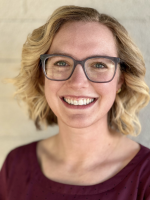
About the Guests:
Elizabeth Estrada is a Cuban American reporter, editor, and producer. As Spotlight PA’s democracy editor, Elizabeth connects voters with the information they needin order toconfidentlyparticipatein our democracy. She helps shape the growth of Spotlight PA’s service journalism around voting and elections through community engagement, partnerships, and interactive tools. Previously, Elizabeth worked at WHYY, Philadelphia’s public radio station, as an engagement editor, where she reported positive stories through her originalFeel GoodFridayseries, launched the station’s first-ever bilingual series, and managed an opinion and essay section. Prior to working in journalism, Elizabeth worked at various nonprofit film organizations, supporting women and diverse media makers.She currently serves as the board chair ofPhillyCAM, Philadelphia’s public access station.Originally from Queens, New York, Elizabeth now lives in Philadelphia. As director of journalism at WITF, Scott Blanchard work on things like newsroom strategy, culture, ethics, and training; he works with reporters (mainly climatereporter Rachel McDevitt) on stories; andhe’sdeeply involved with our community engagement efforts and collaborations with other news organizations.Blanchard came to WITF in 2017 as editor ofStateImpactPennsylvania, a public media collaboration covering the state's energy economy, and we are now a leading source for climate news in the state. He later became senior editor for WITF News andStateImpact, and, in 2022, director of journalism. Before coming to WITF, Blanchard spent more than16 yearsat the York (Pa.) Daily Record, where he was a projects and investigative editor.
Episode Transcript:
Leah Dajches: When you hear phrases like "they're neck and neck," "so-and-so pulls ahead," or "the once front-runner now lags behind," it might seem like you're watching a sporting event. But this type of verbiage has become all too common in elections reporting. Known as "horse race" coverage, this type of journalism focuses on polling data, campaign strategy, and public perception instead of candidate policy. It reports endlessly on the odds of a candidate winning rather than educating citizens about the stakes for governance if they win. Media scholars who have studied "horse race" reporting have found that it increases distrust in politicians and news outlets, can amplify inaccurate opinion poll data, and can ultimately contribute to an uninformed electorate. It's also been found to shortchange female candidates, who tend to focus on policy issues to build their credibility, and hurt third-party candidates, who often are overlooked or ignored by newsrooms because their chances of winning are usually slim. In other words, "horse race" election coverage can pose a real danger to democracy.
But some news outlets are pushing back. What does it look like when journalists implement a style of reporting that focuses on issues important to citizens instead of the agendas set by candidates?
Matt Jordan: To find out, we're going to talk with Elizabeth Estrada, Democracy Editor at Spotlight PA, and Scott Blanchard, Director of Journalism at WITF. With a passion for engagement and commitment to serving communities, Elizabeth Estrada connects voters with the information they need in order to confidently participate in our democracy. She helps shape the growth of Spotlight PA service journalism around voting and elections and general issues as they relate to state government. Previously, Elizabeth worked at WHYY's PlanPhilly as an engagement editor, where she reported positive stories through her original Feel-Good Friday series, launched the station's first ever bilingual series, and managed an opinion and essay section. As director of journalism, Scott works on things like newsroom strategy, culture, ethics, and training. He also works with reporters on stories and is deeply involved with WITF's community engagement efforts and collaborations with other news organizations. Scott previously worked as Investigative and Projects Editor at the York Daily Record, where he helped create a trauma awareness and peer support program. He was a 2013 Ochberg Fellow, receiving training at Columbia University in PTSD science, self-help, and peer support. Both Elizabeth and Scott's teams are committed to avoiding "horse race" reporting and centering democracy in their election coverage. Elizabeth and Scott, welcome to News Over Noise.
Elizabeth Estrada: Thanks for having us.
Scott Blanchard: Thank you.
Matt Jordan: So, what are the challenges that you see coming in the 2024 election? And how does the shift in coverage that both of your news organizations have articulated address these challenges? Scott?
Scott Blanchard: I think the challenges, or one of the major challenges that we still face, is the belief in the minds of a lot of people that something happened in 2020 that didn't happen and that there's something fundamentally wrong with the electoral system and with the integrity of the election system.
I don't think anyone would ever say that a system like that couldn't be improved and maybe shouldn't be improved in certain ways. But I think news organizations are challenged to report contextually and factually as often as we possibly can about what the actual situation is, and not trying to report on the idea that in some certain situations, 2 plus 2 could equal 5, because it doesn't. So, I think that's a big challenge for us. And then for the second part of your question, I think what we are trying to do at WITF is to focus on reporting facts and reporting context, but doing accountability reporting to let people know what the facts are, to arm them with facts, essentially, so that they know that their vote's going to count. And they have information that they can use to refute or turn back or debunk misinformation and disinformation around the election. And then we're going to be as transparent as we possibly can about how we're doing that, so people understand our process. And they can question us. We can talk about it. We'll be open about what we do and how we do it. And we hope that that gives people a greater sense of confidence in the information that we're reporting.
Elizabeth Estrada: Yeah, I second all of that. I think that fundamentally, there's a lot of mistrust which really kind of has been building up since 2016, probably since before then. But we really kind of saw an explosion in 2016 and 2020. And so, at Spotlight PA, we're really hoping to help people navigate those issues. We've been publishing kind of an "Election 101 pre-bunking" series, where we're taking things like voting machines, mail ballots, all these different things that kind of tend to come up year after year that people have questions about, that people are confused about, and where there's a lot of false information about. And we're trying to kind of break it down clearly so that people can be informed with the facts and the truth and really an understanding about how these systems work.
Leah Dajches: And it's a big year. It's a big election year. And we're already preparing for the News Literacy Initiative. And something we've talked a lot about is "horse race" coverage, or "horse race" journalism. And I've noticed both WITF and Spotlight PA have a response to how you're going to handle or not "horse race" coverage for this upcoming election year. Can y'all tell us a little bit more about what is "horse race" coverage and your strategy against it?
Elizabeth Estrada: "Horse race" coverage is essentially, the way that I see it, pretty superficial day-to-day coverage. It's kind of where the candidates stopped this week, what they said about this other candidate, what the polls are saying, what public perception is, rather than really digging into the issues where candidates stand, how they are really kind of similar or different from one another, really providing that value to the electorate so that they can be informed about the candidates that they're having to choose between. As far as where Spotlight PA stands on it, what we are really trying to do is connecting the stakes of this election to Pennsylvanians and how it will impact their lives, why they should care. The other, which we kind of talked about a little bit earlier, is explaining these election systems, how they work, what people should know about them. And then thirdly is combating the misinformation, which I think is kind of the biggest challenge. But really trying to put things out there that clarify and contextualize and share the facts about certain issues that kind of tend to come up time and time again. We're really focused on getting voters the information, having that really voter-centric approach, and filling the gaps that "horse race" coverage really does not get to at all.
Scott Blanchard: Yeah, just to add to that from our perspective. I think, and, of course, cosign everything Elizabeth said. But from our perspective, I think of "horse race" coverage as framing everything in terms of who's leading, almost like it's a sporting event, as though it's the fourth inning and so and so is ahead. And then they could get caught and all of that kind of stuff. And who has the momentum, who said this that blunted their momentum, or whatever. And so, it's framing everything like that instead of framing it around really deep looks at issues or connecting with people. We're doing a lot of community engagement work, where we're basically telling people we're trying to build our election coverage off of what you're telling us you want us to be talking to the candidates about. So, elevate the voters and decenter the candidates is a way of thinking about it. And so, we really want to get at that ground level and stop allowing the candidates to drive the narrative. And like Elizabeth was talking about, this candidate said that thing about this person, and then they responded this way, that's not doing anyone any good, really. It's not getting into the issues. And it's also not-- the other thing that we're-- one other thing that we're trying to do at WITF is pay attention to what we call "democracy framing," which is really looking at stories about elections and voting and administration and so forth in terms of what does this mean to what we have witnessed as attacks on the electoral system in 2020 and the aftermath of the 2020 election. And so, all of these things have this deep context. And they're not coming out of nowhere. And so, when you hear about a legislator proposing some kind of a change to the electoral system, we want to look at that and say, well, how does this relate back to what happened in 2020 during the election, after the election, through January 6, and really then beyond? And how does that fit into this narrative of particular actors attempting to really undermine the system or dismantle it, really? So that democracy framing is important to us as well.
Matt Jordan: Scott, I was wondering how your approach addresses the problem of political parties setting agendas that are anti-democratic. I mean, there's been a long debate in America about the problems of factionalism in democracy. And one of the things that "horse race" coverage often does is focuses the coverage on what the partisans say instead of what people want. So how are you flipping the tables on that scenario?
Scott Blanchard: By doing the community engagement that I talked about in a number of ways that ranges from we have texting clubs. We do small group listening sessions. We do larger group listening sessions. We're putting on a deliberative forum with some partners in Lancaster this weekend. It's not a public event, but it's an event to bring a demographically representative group of people together to discuss issues about-- in this case, it's why isn't democracy working the way you think it should work or would like it to work? and to get at that. So those community engagement efforts are what are giving us the information that we can take and then say, well, this is something that people are concerned about, so let's build a story out around this. So, by doing that, we are attempting to build our coverage in a way that means we don't have to go to the candidates to get a quote for x, y, or z. And we don't have to wait for a news release. And we don't have to wait for a policy proposal or respond to that. And certainly, as Elizabeth was saying, we don't have to look at a poll, or we don't have to look at those kinds of day-to-day things. What we're trying to get at is to do the stories that matter to people on the ground with the issues that they see when they walk out their front door every day to go to work or school or whatever. So that's how we're trying to flip it.
Leah Dajches: If you're just joining us, this is News Over Noise. I'm Leah Dajches.
Matt Jordan: And I'm Matt Jordan.
Leah Dajches: We're talking with Elizabeth Estrada, Democracy Editor at Spotlight PA, and Scott Blanchard, Director of Journalism at WITF, about an approach to election reporting that focuses on issues instead of candidates. Elizabeth, I saw on Spotlight PA, y'all are also really putting the citizens and the voters first. Are you doing similar practices to WITF in order to do so?
Elizabeth Estrada: Yeah, I think that our approach is a little bit different. We're really trying to fill the void for a lot of the information that doesn't exist out there. So, our focus is mainly statewide elections. So, for example, for the row offices, we have done a bunch of different guides for attorney general, for auditor general, for treasurer, knowing that information regarding the presidential election, people can find. For the US Senate, there's two candidates, one Democrat, one Republican, We're going to continue reporting on that throughout the year. But we're really trying to fill the voids in information when it comes to the specific candidates, especially for the primary, when for the attorney general election, there's five Democrats and I think two Republicans. How are you supposed to choose if you don't even know who these people are, or you don't even know what an attorney general does and what they're responsible for? So, we're really kind of starting on a one-on-one level in that sense around engagement. We're lucky to have a really engaged audience. And so, they let us know what they're thinking about, what's going on in their counties and their communities. They let us know feedback, whether it's constructive or positive, about what we put out there. And then, of course, we have our government team, our reporters on the ground, who are really observing and absorbing what people are talking about, what's missing, and using that to inform a lot of our guides. But also taking a look at what are the things that come up election cycle after election cycle, especially when it comes to misinformation that people can be easily misinformed by and trying to just break that down and have it out there for voters.
Leah Dajches: What's interesting to me is that research shows that "horse race" coverage doesn't actually benefit the candidate, but it also doesn't benefit citizens. So, I'm wondering who wins with that format of coverage of reporting?
Scott Blanchard: The news organization that's trying to get clicks on its website. That's why. Because if you put a story on your website that says candidate A leads candidate B by five percentage points, people are going to click on it. And then two weeks later, if you have another story that says candidate B is closing in on candidate A and only trails by three percentage points, people are going to click on it. News organizations know that. So, then it becomes a decision of are you going to do that, or are you going to do something different that you think will better inform people, better represent people, and especially people who have not traditionally had a voice in news organizations? Are you going to do that? And news organizations can make that decision. You don't have to publish poll stories about who's leading and who's closing, or whatever it is. You do not have to do that.
Elizabeth Estrada: Yeah, but that's easier to publish an article that is about who's leading who rather than try to organize something for the communities that you're in and ask them, what questions do you have? What do you want to see? That's the harder task. And so, I think, Leah, like you asked, who wins? I think it's really, who loses? There's so many more people that end up losing than winning when you publish that kind of "horse race" coverage, or at least when that's exclusively what you're publishing.
Matt Jordan: One of the things that we know from research about national kind of partisan news organizations, which are increasing like mushrooms, is that they tend to set agendas for the nation. And one of the things that people have identified with the kind of drying up of local news is that those rich local contexts have been replaced by these national agendas. So, I'm wondering, how do you deal with this for both of you when you're talking with local people and you hear the agendas of national partisan news orgs seep into those conversations? Do you push back on those things? For example, if you're in a town like Chambersburg and they're talking about what's going on at the border, do you try to find another story? How do you deal with these very partisan agendas that are set by national media?
Scott Blanchard: We actually did that on a story when Trump came to speak in Harrisburg at the NRA event. And we knew that when we went there to talk to people, we would get people talking about the national agenda. So, we had a meeting beforehand to talk about if you get that, try to get to the next-level question of the border is an issue. Well, how is that affecting what you encounter in your daily life, in your town, in your neighborhood? And try to get down to that ground level. And if there's something there, then there's something there. But we had a little bit of success in moving people off oh, well, in my town, it's really, you know, x. And it wasn't the border or the major issue, the major talking point of a political party. So, I think that's one way. That's one way, and we'll keep trying to do that.
Matt Jordan: Both of you have said that you're trying very hard to counter the misinformation that a lot of partisans try to, how shall I say, propagate in the news media ecosystem. So, what are your strategies for dealing with bad faith communicators who keep repeating things that have been debunked many, many times?
Elizabeth Estrada: In our stories, we just will quote them and just say, despite them saying this, this is not what happened. And we just-- they repeat it, and so we keep repeating what happened or the facts and linking to previous reporting. And you kind of have to summarize. It's like, Trump claimed fraud in the 2020 election, and I encourage supporters to hit up the Capitol. And that's what happened. And you have to contextualize that. And it's like, this is what he claims. And also, this is what was found. Those claims are unsubstantiated. But when we contextualize things, sometimes that makes people unhappy. And so, after that went up, I did receive a not happy email from somebody who was disappointed by the fact that we put that out there, and, as a result, said that we actually are not nonpartisan, that we clearly have an agenda. And if that's the cost of putting out the facts, then that's just an unfortunate symptom that we have to deal with. But that's kind of what we've been doing.
Scott Blanchard: Yeah, I think the big thing is context. And I think the phrase "truth sandwich" is kind of what Elizabeth is describing. But you state a fact, and then you say what the bad faith actor says about it. And then you state another fact, or the same fact, in a different way. And you kind of bracket the misinformation or the bad information with facts. So, you're doing everything you can to send a clear signal to the reader that this person doesn't know what they're talking about, or they are acting in bad faith. They're telling you something they know isn't true. So, context is a big deal. And we have had since the end of January '21 an accountability policy where when we air or publish a story that quotes a lawmaker who had taken one of four actions in support of the election fraud lie in 2020, we will add that information. It'll be in what we call a "breakout box" online, or it will be what we call a "host tag" on radio, something that the listener will hear the host say. As part of our accountability policy, we'll note that Representative So-and-So took this action in 2020 that supported the election fraud lie which led to the attack on the US Capitol. And so that's a way to keep that information out there and make sure that people understand, again, the roots of all this go back. These things that we're hearing about today and reporting on today in terms of elections and voting and election administration and all that, they're not coming out of nowhere. They're coming out of a very specific place. And you can connect the dots all the way back. And so, we want to do as much of that as we can. But outside of that, I think it is very much what Elizabeth said, which is add as much context as you possibly can. And the other thing I would say is that we're not obligated to quote somebody saying, "2 plus 2 equals 5." If we know that that's not true, we don't have to report that the sun rises in the west. We should report facts. And so, we can use that kind of news judgment and awareness and facts to guide what we publish. And if we're dealing with somebody, a source who is saying something that is misinformation or that we know is incorrect, we should be challenging that. Our reporters should be challenging that in the moment. No, that's not factually correct. What is the point you're trying to make here?
Matt Jordan: One of the things that people talk about in relation to why news orgs do this type of thing where they just let people talk and don't really correct them is access. Have you had blowback to doing accountability journalism since 2021 at WITF, where people won't talk to you anymore?
Scott Blanchard: Yes. I mean, yes. There are some Republican lawmakers who will not talk to us. And I would put Scott Perry-- Representative Scott Perry is definitely in that group, although at this point. Scott Perry might not talk to any media outlet that he doesn't consider to be favorable toward him because he had a central role, the evidence shows, in Trump's attempt to stay in power. So, I'm not sure if he's talking to anybody. But I know that he is one who has not-- we've reached out multiple times, and he has not returned our calls. And then there are state Republican legislators who won't return our calls. And we just have to figure out other ways to get information or to get-- it's not that we're in the business of just getting quotes or whatever, but just find other ways to talk to people who will engage with us.
Leah Dajches: Something that I really appreciate and enjoy about both WITF and Spotlight PA's approach to this election cycle is putting that citizen first, listening to citizens. And something that we really strive to do is give agency, autonomy, news literacy skills to our listeners. And so, what tips or advice do you have for listeners as they prepare for what is going to be a big election year but also going to be, I think, very messy? There's going to be a lot to wade through. What tips and advice do you have?
Elizabeth Estrada: Oh, my. Well, I think you can visit WITF, listen to ITF, visit Spotlight PA for information you can trust on elections. But furthermore, I think that think like a reporter and be a little skeptical. I think if we all approached the information that we come across, which nowadays we aren't even necessarily searching for. It's finding us because it's targeting us. It's coming up on our news feeds on social media. And so, if you find something, just take a moment. What is the source? Who wrote this? Can I verify this? Has this been reported elsewhere? I think that social media has really altered, to some extent, the way that we process information. And I feel like for so many of us, even those of us who are journalists and work in news, I think it's easy because it's made to look so real and so factual. And so, it's so easy to believe. And I think when that happens, just retrain ourselves to just say, hold on. What is this? What is this news source? Can I find out more information about that? Just simple things like that. And that's if you're just randomly scrolling about and information comes to you. But I think you can also be proactive and seek information from trusted sources, like your local NPR affiliate station. There's SpotlightPA.org for more statewide issues. Really credible, reliable news sources, they exist all over in Pennsylvania, across the country. And kind of start there for regular news consumption and information. You can subscribe to newsletters. You can listen to the radio. There are TV shows. But I think when you're just randomly coming across something that you've never heard about before, or maybe the information is really sensationalized and it feels kind of like, hmm, is this true? Did this really happen? Think like a reporter and ask a few questions. And try to figure out, can you verify this information? And if you can't, then maybe it's not real. I can't remember the statistic, but I went to this convening at the end of last year around democracy. And there's, I believe, more AI-generated fake news websites than there are real, actual news organization websites out there now. And that is super concerning. That is super troubling. And that means that, unfortunately, the onus is on us as individuals to sift through some of that stuff and try to figure out the tools that will work for us so that we don't fall for the misinformation that's out there. Because it's targeting us. And so, it's doing what it's supposed to be doing. And it's up to us to ask some questions and try to think more critically about what we are finding online.
Scott Blanchard: Yeah. To Elizabeth's point, when people are putting out misinformation or disinformation, they know what they're doing. And they are playing on the human tendency to believe what you already believe or what you really want to be true. And once you know that, once you know that they're coming after you in that way, it helps you do what Elizabeth is talking about, which is take a step back and go, hang on, hang on, hang on. I need to check this out. Because it's got me really excited when I read it because it's against the candidate that I don't like. But I need to check this out. And then crucially, Spotlight is not putting out misinformation. And beyond that, they're working as hard as they possibly can to put out correct, factual, truthful, reliable information. Same with us. There are other news organizations that are doing that. To Elizabeth's point, you can read Spotlight, ITF, other public media, other news organizations across the state, and check their stuff out. And it will check out. And information from sites that are trafficking in misinformation will not check out. And you can do some of that work. It does take work. It's not the quick fix that we all-- that we all like to have. But you can do that work. And you can assess the credibility of the news source. And once you do that, once you know that people are trying to play you and that you can go to credible news sites to get real information, that's a good part of the battle right there.
Leah Dajches: This is all so important for us, for our listeners, as we head into this election year. And so, I want to thank you both for joining us today.
Elizabeth Estrada: This was great. Thanks so much for having us.
Scott Blanchard: Thank you. It's fun to be here.
Matt Jordan: That was a really interesting conversation, Leah. So, what are some things that you think are worth chewing on a little bit?
Leah Dajches: Yeah, absolutely. The first thing that's worth chewing on is just the idea of "horse race" coverage. But something I really liked that Elizabeth quoted that's akin to that thinking about how can we combat against that was her quote, "think like a reporter and be a little skeptical." And I love that in the context of news literacy. But I also think it's so applicable when we're encountering any media, whether it's who's Taylor Swift and Travis Kelce going to be endorsing, or who's in the lead on the election. I think that's a really helpful kind of mantra to think about as we are faced with so much information this election cycle. Matt, what's something-- what have you been thinking about?
Matt Jordan: Well, I find it really inspiring in a way. People have been criticizing bad political coverage for a while, whether it's the "horse race," who's ahead in the polls, or whether it's things like game or conflict framing that make all issues about who is it a win for, who is it a loss for? And to see that both of these news organizations use something like the Citizens Agenda model to flip the tables on the partisan communicators and to put the interests of the citizens first is something that gives me a lot of hope.
Leah Dajches: That's it for this episode of News Over Noise. Our guests were Elizabeth Estrada, Democracy Editor at Spotlight PA, and Scott Blanchard, Director of Journalism at WITF. To learn more and to hear an extended version of this interview with additional content, download the podcast at wherever you subscribe to podcasts, or at newsovernoise.org. I'm Leah Dajches.
Matt Jordan: And I'm Matt Jordan.
Leah Dajches: Until next time, stay well and well informed.
Matt Jordan: News Over Noise is produced by the Penn State Donald P. Bellisario College of Communications and WPSU. This program has been funded by the Office of the Executive Vice President and Provost at Penn State and is part of the Penn State News Literacy initiative.
[END OF TRANSCRIPT]
Episode Credits:
Producer: Lindsey Whissel Fenton
Audio Engineers: Mickey Klein, Scott Gros, Clint Yoder
News Over Noise is a co-production of WPSU and Penn State’s Bellisario College of Communications. This program has been funded by the office of the Executive Vice President and Provost at Penn State and is part of the Penn State News Literacy Initiative.