-
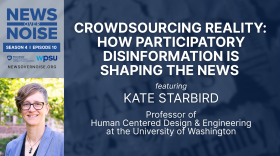 Misinformation is often described as something that’s created and then spread, but increasingly, it’s shaped in real time through participation. In this episode of News Over Noise, Matt Jordan and Cory Barker talk with Kate Starbird about participatory disinformation and how online audiences help produce, remix, and amplify information as it moves, blurring the line between observer and actor. THIS EPISODE CONTAINS EXPLICIT CONTENT
 -
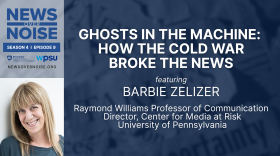 In the early years of the Cold War, American journalism helped construct a world defined by enemies, uncertainty, and invisible threats. That framework didn’t disappear; it became embedded in how news is produced, interpreted, and trusted. In this episode of News Over Noise, Matt Jordan and Cory Barker talk with Barbie Zelizer about her book How the Cold War Broke the News and the enduring influence of Cold War logic on contemporary journalism.
 -
 In this episode of News Over Noise, Matt Jordan and Cory Barker talk with Timothy Richardson of PEN America about how rhetoric has shifted into action and discuss why press freedom organizations that once focused overseas are now turning their attention back home.
 -
 Local newspapers have long played a central role in how communities understand themselves, but that role is becoming harder to sustain. In this episode of News Over Noise, Matt Jordan and Cory Barker talk with journalist Tony Norman about the unraveling of the Pittsburgh Post-Gazette and what its decline reveals about the broader transformation of American journalism.
 -
 Young people are often described as disengaged, overwhelmed, or indifferent to the news, but those labels miss what’s actually happening. In this episode of News Over Noise, hosts Matt Jordan and Cory Barker talk with Rachel Besharat Mann, Associate Professor of the Practice at Wesleyan University, about how adolescents and young adults navigate news in social media environments. Drawing on her research, Mann examines news avoidance, algorithmic trust, influencer culture, and the role of identity, emotion, and wellness in shaping how young people interpret information and develop early civic identities in a platform-driven media landscape.
 -
 As prediction markets move from the fringes into mainstream news coverage, questions about ethics, accountability, and public trust are becoming harder to ignore. In this episode of News Over Noise, hosts Matt Jordan and Cory Barker talk with Judd Legum, founder and editor of Popular Information, about the growing influence of prediction markets like Kalshi and Polymarket and what happens when the logic of gambling collides with journalism. The conversation explores the financialization of public opinion, the erosion of editorial judgment, and what’s at stake when human consequences are reduced to probabilities and payouts.
 -
 Misinformation now moves at the speed of algorithms and with generative AI, it is getting harder to tell what is real and what is manufactured. In this episode of News Over Noise, hosts Matt Jordan and Cory Barker talk with Sofia Rubinson, analyst at NewsGuard and senior editor of Reality Check, about how false claims spread, why AI is accelerating their reach, and what that means for public trust. From viral images and foreign disinformation campaigns to health hoaxes and AI-generated content, Rubinson breaks down how false stories move from fringe platforms into the mainstream and how NewsGuard tracks, debunks, and analyzes those narratives in real time.
 -
 As political pressure, corporate power, and platform dynamics collide, long-standing protections for free speech and a free press are being tested in new ways. In this episode of News Over Noise, hosts Matt Jordan and Cory Barker talk with Dr. Amy Sanders, Penn State’s John and Ann Curley Chair in First Amendment Studies, about what the First Amendment really protects and how legal frameworks, business interests, and political forces are reshaping the Fourth Estate.
 -
 When student journalists at Indiana University published routine accountability reporting, they did not expect rising pressure from the institution they were covering. Behind closed doors, university leaders began to question editorial decisions, push advisers to intervene, and restrict the independence that had long defined the newsroom. In this episode of News Over Noise, hosts Matt Jordan and Cory Barker talk with Jim Rodenbush, former director of student media at Indiana University, about the events that led to his removal, the political climate surrounding universities, and the growing divide between public relations priorities and independent reporting. The story in Indiana reflects a larger national trend that affects press freedom, the future of student media, and the communities that rely on young reporters to fill widening gaps in local news coverage.
 -
 Artificial intelligence is reshaping how we create, consume, and trust information. In this special crossover episode of News Over Noise, Cory Barker and guest co-host Jenna Spinelli explore AI’s impact on news, education, and democracy with Sean Marcus of the Poynter Institute, Pamela Brunskill of the News Literacy Project, and Jenna Meleedy of the National Association for Media Literacy Education. Together, they unpack the rise of deepfakes, the “liar’s dividend,” and how educators are helping students mind the gap between breaking news and verified information. They also share strategies for navigating misinformation, using AI ethically in the newsroom, and maintaining trust in an era when technology can fabricate anything.

© 2026 WPSU

Public Media for Central Pennsylvania
Play Live Radio
Next Up:
0:00
0:00
Available On Air Stations


