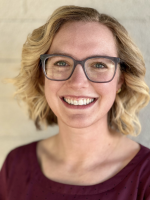
About the Guest:
Lewis Raven Wallace (he/they/ze) is an award-winning independent journalist based in Durham, North Carolina, theauthorand creator ofThe View from Somewherebook and podcast, and a current Ford Global Fellow and Abolition Journalism Fellow with Interrupting Criminalization. He previously worked in public radio, and is a long-time activist engaged in prison abolition, racial justice, and queer and trans liberation. He is white and transgender, and was born and raised in the Midwest with deep roots in the South.
Episode Transcript:
Leah Dajches: Early in the Trump presidency, a transgender journalist was struggling to make sense of the new administration and its slew of controversial executive orders. After spending his day reporting for the Marketplace Morning Report, this journalist published a blog post on medium.com. The post was titled, “Objectivity is Dead, And I'm Okay With It.” To give you a sense of the tone of the piece, here's a short quote. Instead of waiting and seeing reacting as journalists are arrested, freedoms of speech curtailed, government numbers lied about, I propose that we need to become more shameless, more raw, more honest with ourselves and our audiences about who we are and what we are in this for. Hours after publishing this post, the reporter was suspended on the grounds that he had violated Marketplace's ethics code specifically related to objectivity and neutrality. After temporarily removing the post, the reporter decided to put it back up. The following Monday, he was fired. Ultimately, he was told that he could not be both an activist and a journalist at the same time, an opinion that he respectfully disagreed with.
Matt Jordan: That reporter was Lewis Raven Wallace, an award-winning independent journalist based in Durham, North Carolina, and our guest on this episode of News Over Noise. Wallace is the author and creator of a book and a podcast called The View from Somewhere, and a current Ford Global Fellow and Abolition journalism fellow with interrupting criminalization. In addition to his past work in public radio, Wallace is a longtime activist engaged in prison abolition, racial justice, and queer and trans liberation. He's white and transgender and was born and raised in the Midwest with deep roots in the South. We're going to talk with him about how the mandate of objectivity creates challenges for reporters navigating the rise of anti-democratic politics in America and what can be done to restore some of the lost public trust in journalism.
Leah Dajches: Hi Lewis. Thanks for joining us today.
Lewis Raven Wallace: Hi. Thanks for having me.
Leah Dajches: In your blog post, you say that objectivity is dead. Can you explain this a little bit for our listeners?
Lewis Raven Wallace: Sure. So that was kind of statement of the moment because there was so much talk at that time about nothing's objective anymore and fake news. And when I wrote that post, it was I think three or four days after Kellyanne Conway had gone on Weekend TV News and talked about alternative facts. And so there was this kind of truth panic happening of there's no more objectivity and what are we going to do? And so what I was trying to do was reach out to readers of my blog and say maybe there's a different way of thinking about the end of objectivity or the death of objectivity, which is to acknowledge that for many of us, it's actually never been real. It's never been the right kind of ethical construct for thinking about the news. And that comes from my perspective as a transgender person kind of seeing my community and identity constantly misrepresented by supposedly objective or neutral news sources and understanding that there's really no neutrality, it's usually just a reflection of status quo thinking or a performance of neutrality and objectivity that we're dealing with. So if we can admit that it's all just a performance, then we can talk about how do we construct true stories and what are the values that drive that.
Matt Jordan: So, a little follow up on that. Where did that notion of objectivity come from? How did that emerge as a status quo and dominant idea in journalism?
Lewis Raven Wallace: I was kind of surprised to learn in the research for my book that objectivity as a newsroom value, at least in those terms, wasn't even really around until the 1930s. So it's been less than a hundred years that we've had self-identified objective news sources. For about a hundred years before that, there's a kind of developing unfolding idea that news outlets should reflect both sides of partisan divides. And the initial reason for that concept was actually economic. It was a way to sell more papers in the 1830s and 1840s when publishers decided to print these things called penny papers and distribute them to a lot of people and make their money off of advertising, it made sense to not appear as partisan in that context. So it was kind of cooked into the business model of print newspapers specifically and then later developed as more of a professional ethos starting in 1890s, early 1900s when journalism schools were first launched. And it was like we're trying to professionalize this and create some line between just a person saying stuff and a journalist. And so we're going to set some standards around that, many of which are good standards, but some of which are, I think these kind of false standards of neutrality or non-bias or outsider-ness that really took hold a little bit later in the 20th Century.
Matt Jordan: So stylistically, how do those manifest themselves? You've talked a second ago about how certain types of stories or perspectives aren't covered, but what are some of the ways stylistically that somebody performs being objective?
Lewis Raven Wallace: There are so many examples from different moments in time. One that comes to mind that comes from a personal experience when I started working in newsrooms, I was writing a story about a kind of radical Christian right group that was advocating against trans youth being able to use the bathroom reflective of their gender identity in high school. And that was 10 years ago. And that whole movement, as you all probably know, has really taken off, but it sort of felt like a fringy thing at the time. Anyway, this radical Christian group was saying this, and in the initial draft of the story that I turned in, I described them as an anti-gay group. My editor at the time said, that's probably conveying a kind of bias on your part to describe them that way. Can we describe them with a more neutral terminology? And I can't remember what we landed on. It might have been Christian Right or something like that. So, that's an interesting one to me because it's not that it wasn't an anti-gay group, it is, it's that we didn't want to upset people who might be sympathetic to that group by describing it in those terms, in part because some of the folks who hold those beliefs, they don't consider them anti-gay or anti-trans beliefs You know, a lot of people who support racist policies don't like to be called racist or to hear those policies called racist, but as journalists, I think part of our job is to bring that level of analytical truth to what we're doing and be able to say when a given sort of policy or practice is racist in its effects.
Leah Dajches: I was listening to your podcast the other day, and there was a great quote from one of your early episodes from Ramona Martinez about objectivity and status quo, and it's objectivity is the ideology of the status quo. And that line has just really stuck with me. I'm wondering if this is getting at this idea that those who are outside of the mainstream cannot be or are not considered objective.
Lewis Raven Wallace: Yeah, totally. And I think there's something what Ramona said is so interesting to me because it kind of reveals how ideological actually everything is. So if somebody says to me, I don't have an ideology or I'm just neutral on X, Y, Z, I always think to myself, it's probably more likely that you're just not aware that you are working in an ideological framework. And it's easy not to have that awareness if your ideology is reflected everywhere around you. That's why Ramona calls it the ideology of the status quo. So trans people and non-binary people in the late 1990s, which is when I came out, in order to come out and be ourselves, we had to assert this ideological interruption of the dominant belief that there's two genders and you're born a man or a woman. And that's a really, really deeply held ideological framework in our society that now is threatened and people are freaking out. But at the time, it was like you couldn't even have a conversation about it without touching upon those ideological assumptions. And so the idea that news is produced sort of outside or separate from that somehow to me is just impossible and ridiculous. News is either reproducing the dominant ideology or making space for arguments and experiences that challenge that, and often both. And there's no perfectionism that we're going for there either but just to be honest about how important our role is as journalists in shaping reality.
Matt Jordan: In the experiential examples you're giving drawn from your own experience as a reporter, you describe in each case that there was a worry on the side of an editor who said, make this change, tone it down a little bit. It strikes me that that's very different from saying this isn't true, right? It's saying this might offend somebody. I'm wondering how you think that fits with the idea of journalism in the first person, which is to provide people with access to the truth so they can make decisions as a citizens of a democracy. Do you think that those things are antithetical or what's the tension between avoiding criticism and telling the truth?
Lewis Raven Wallace: I think so much of that tension is about the business aspect and capitalism and sort of the business model of journalism. I think when we look at the history of he said she said this side that side reporting that emerges from that need to sell more papers. And then I think still today, those editors bringing those fears, that's what they are. They're fears, as you said in your question, they're not really tied to whether or not this is a true statement. It's like, is this going to upset people? And I think that we can't underestimate the power explicit and implicit of funding sources and business models in driving that kind of thinking. I think that's also why independent journalists and journalists who've sort of stood outside of those institutions have sometimes been able to tell the stories that no one else will tell.
Matt Jordan: Do you think readers respond to that better than the stuff that is supposed to avoid criticism?
Lewis Raven Wallace: I think it depends. I think objectivity is such a widespread belief system that a lot of people feel like if you're not giving the performance of neutrality, it's bad and it's fake news. So I think there's often still an advantage for journalists of giving aspects of that performance. And I really want to see a fundamental change in news literacy and how people understand the process of making news so that it's not about whether it's performing the objectivity, it's about whether it's well reported, researched, and verified, and saying to some extent who we are and where we're coming from and how we came to the conclusions we came to is a way to have that conversation with readers and listeners that can be really powerful. Because it's about transforming their expectations of us and our expectations of them.
Leah Dajches: I'm wondering instead of striving for objectivity in journalism, what should the goal be instead? Should we be focusing more on transparency, authenticity? What are your thoughts on that?
Lewis Raven Wallace: I love transparency. I think that's a really interesting and complicated ethical value to strive for. I also for myself, I strive for rigor in journalism. So I don't want people to get the idea that because we're not talking about objectivity anymore, we're not talking about rigor either. I think that being rigorous and thorough and double, triple checking things and being careful and intentional is one of the most wonderful skills that journalists can develop and bring to the work that also helps with building trust. I'm interested in the value of accountability, being aware for journalists of who we're accountable to. What community or communities or individual people, and then how we practice that accountability. And for me, everything is about power and the struggle over power and oppression in terms of class, in terms of race, in terms of gender is underlying or running through almost all of the stories that we do. And so journalism that challenges power, that challenges oppression, to me that's another kind of post objectivity value that I pursue, and that we see more and more journalistic organizations also openly pursuing, which I think is great.
Leah Dajches: If you’re just joining us, this is News Over Noise. I'm Leah Dajches.
Matt Jordan: And I'm Matt Jordan.
Leah Dajches: We're talking with Lewis Raven Wallace, an award-winning independent journalist about the concept of journalistic neutrality and about what can be done to restore some lost public trust in journalism. I want to talk a little bit about public media. I was having a discussion with a colleague today and we were talking about objectivity. They were suggesting that a possible solution to this question of objectivity is for news consumers to focus less on mainstream news, the news that's marketing to that mass appeal and really depends largely on advertising rates. So instead we were suggesting that news consumers should look for public media, should look towards consuming local news, public news. How do you see public media fitting into this conversation of objectivity?
Lewis Raven Wallace: I think public media was a visionary concept when it was created. Globally and in the United States it's played out differently in different places. But in the US it was quite a progressive idea that we should have this segment of the public airwaves that isn't privatized, that's accountable to the people more broadly. And it was a way of resisting corporate dominance in on air news media, which I think is really wonderful. I think that something that's happened with a lot of public media stations as they've corporatized, felt that same pressure to endlessly grow and to perform objectivity, which there's a little bit of complicated legal stuff about that too actually in terms of how the National Broadcasting Act was written. But with all of that said, I still think even with that shift toward a more corporate model in some public media, that local and public airwaves that are accountable to the community is one of the best ways and places to create the journalism that we need today. As much as I have my own complicated history with public media, I always encourage people like, "Support your public radio station and criticize it. Call in and say what you want to hear. Involve yourself rather than become uninvolved." Because it is such an important resource that we have.
Matt Jordan: There's been a lot of call for pro-democracy journalism. What, in your perspective, what would pro-democracy journalism look like?
Lewis Raven Wallace: Ooh, pro-democracy journalism would be freaking out about what's happening in democracy in the US right now. I live in North Carolina where for 10 years or something, North Carolina has been rated below several comparable non-democracy countries in the world. You can assess North Carolina's level of representation and involvement and find that it's actually not a democracy. So how is that not a story right now? You know what I mean? That shouldn't be some progressive fringy weird thing that people are just hearing right now while I'm saying it, or reading on policywatchnc.com or something. That's a huge democracy story, that it's so gerrymandered that people have been so disenfranchised in this state that it wouldn't even be considered a democracy by an international outside assessor. That's crazy. So I think that a pro-democracy journalism would be freaking out about things like that. Those would be constant big stories. There would be no coverage of the totally bogus right-wing mythology about voter fraud that has led to and justified the disenfranchisement of so many, particularly low income and black and indigenous and people of color through voter ID laws. All of that would need to be handled very, very, very differently by the news in order for us to be doing, I think a really good job of advocating for democracy through journalism or protecting democracy through journalism. I think another way that it would look really different and that it does look really different in some of the local news outlets that I've been following and working with, is that engaging people would be a front and center priority at all times. So rather than put the story out and try to get the clicks and shares and the advertising money and whatever, the goal would be to engage and activate people and stories would be assessed not based on how many people read them, but based on how many people took action in response to them. And that's a whole different way of thinking about the purpose of journalism.
Leah Dajches: What would that look like? What does it mean to engage and activate readers and news consumers?
Lewis Raven Wallace: I think there's a lot of different ways that can look. Some are really in the content of the story and some are in the format. So I think in terms of content, actually talking through what a different local community did to address this issue, that can be an example of something that might engage people in local communities everywhere to say, "Oh, these people dealt with this problem of water access by taking these action steps." So that's the sort of solutions journalism model of you cover solutions and cover what people are doing. I think another way that stories might engage people in action is by having a follow-up that brings people together. Actually doing the kind of community organizing work around the story. So you're not just out there talking to people while you're reporting it and then you put it out and it's over. It's like, "Oh, here's this story. Now let's have a public forum about it. Now let's have conversations. Now let's follow up with the stakeholders who are involved and sort of continue." Look at the story as just one part of the puzzle. And then I think another way that's... There's this outlet called Outlier Media in Detroit that I'm a really big fan of, that their initial point of contact with all of their readers is through cell phone text messages. So you can text an address in the city of Detroit to Outlier Media's number, and what you'll get back is all the public records information about that house. So who owns it? Are there back taxes on it? Is the house in court for one reason or another? And the reason that all is important is because housing is kind of the number one issue for low income people in Detroit. And the number one thing that people are asking about when they make 411 calls. And so, they text Outlier Media, Outlier Media writes them back with all this public records information that would otherwise be quite hard to find in one place, and then they have an actionable, a bunch of actionable information about the home that they're considering buying, renting, or moving into. And so they're sort of a direct service aspect to that. And then Outlier allows people to follow up and say, "I have more questions." And a reporter from outlier calls people and talks to them about their questions. And then sometimes out of that, they end up producing a story that's more published on a website or goes sort of outward toward a more general audience. But in a lot of ways it's direct economic news for the consumer, which people aren't familiar with for low income people. We get a lot of direct economic news all the time about things that rich people value, like the stock market. But when it comes to the things that sort of shape the lives of low income people every day, the idea of like, "Oh, you should be able to access all the information that you need about your economic future," is not as common of an idea. And Outlier Media just says, "That's what we're going to do, and we don't care if you don't think it's journalism." So I love them.
Matt Jordan: When we've talked with journalists and when I've read about journalists talking about this stuff, advocacy is a really dirty word for a lot of people, right? Some in our journalism department who use that as a, "No, you can't do that. You're advocating." So, make a case for why advocacy would be a better type of reporting for democracy.
Lewis Raven Wallace: So, yeah, I mean think to start with, I don't think that I believe that there's sort of advocacy journalism and non-advocacy journalism. I think all journalism is representing some ideological stance, whether it admits it or not. I think with that said, we have to look to history and how journalists like Ida B. Wells or Marvel Cooke or Ruben Salazar were the only people positioned to tell stories about, in some cases, state violence, in some cases, economic exploitation against the communities of color that they were a part of and the way that they told those stories was completed intertwined with their allegiance to and advocacy for the community. You know, that's the role of journalists who have stood with, and alongside targeted communities forever. The gay newspapers, I read a bunch of the gay papers from the early '80s when a bunch of them were sort of popping up at that time, and there's pages and pages of columns just about murders of gay people, gay people being arrested, gay bars being raided, gay bars being arsoned. So, is that advocacy journalism? Sure, because you have to advocate for your community. But, to me, it's sort of a non-issue in a way. So, the dominant newspapers in the 1980s wouldn't even say the word gay. So, gay people are going to make their own stuff. I think we could shift the whole dynamic around that by teaching those community advocates and community driven outlets as just journalism, another kind of journalism. I think this idea that there's sort of advocate and non-advocate journalism is very oppressive and repressive and has actively been used to keep... I mean, really specifically, to keep gay people and people of color out of newsrooms and keep those stories out of mainstream papers. So, I think that the sooner we can dispense with that whole kind of mindset, the better.
Matt Jordan: That reminds me of, in the progressive era, there were a lot of journalists who were arguing that the real power was not about how you covered a story, it was just the choice to cover a story or not, right?
Lewis Raven Wallace: Yeah, totally.
Matt Jordan: So, much of the oppression is just really not covering something, right? Because when you're covering stories of oppression, there's a story there but it's really just about the choice to speak about something that just normally isn't covered, that is really where the power is in the news dynamic.
Lewis Raven Wallace: Yeah, and like we're dealing right now with a kind of rising force of specifically kind of right wing advocates who don't want Black history taught, who don't want gay and trans issues talked about in schools. To me, the implications of that very clearly extend to our jobs as journalists because if we're catering to the status quo, at some point where that leads is like, "Don't say gay," which is where we were just a couple decades ago, and I don't want to go back there myself, and so if that means I'm an advocate, then so be it.
Leah Dajches: Yeah, and-
Lewis Raven Wallace: I think in this country we're just so acculturated to individualism and careerism, and journalists are no different than anyone in any other career, especially professionalized career in that sense. This idea that you sort of adhere to the standards of your job or workplace at the expense of being in solidarity with oppressed communities is a very helpful idea for capitalism and not a very helpful idea when, again, when you're the one in the cross hairs. So, there's a kind of unlearning there of our own individualism when we start to rethink journalism as something that's really for and with the collective.
Leah Dajches: We were talking about how the decision to cover or not cover a story kind of impedes progress could lead back to the us saying, "Don't say gay." And it had me thinking of how to connect that to this idea of objectivity that if we're reporting on something, so we're covering it, but we're doing it in an objective way and trying to be neutral. It could be a stretch, but could we almost think of objectivity in this context as being antithesis to progress, to moving forward as a society?
Lewis Raven Wallace: That's a great question. I mean, I think for me, that's like a yes, and. I do think at this point in this era, there's something kind of regressive about clinging to objectivity, and with all of that said, I'm sort of resistant to the framework of constant progress or a progressive history, I guess. I think we're always going to be in battle, we're always going to be having a back and forth about power and control and groups of people and who's in charge, and there are more liberated and healthy and democratic ways that that can look, and then there are very fascistic and totalitarian ways that could look, but I think the sort of power struggle is always going to be there, and so objectivity to me is like a framework of a historical moment that is over. So, it's already ended. We're in post-postmodernism already.
Matt Jordan: Well, Lewis, thanks so much for joining us and helping us negotiate this post-modern world where objectivity is maybe something we shouldn't be clinging to quite so strong. It's a conversation that we have been having, and we thank you for joining us for more of it.
Lewis Raven Wallace: Thank you for having me. It was great to talk with you all.
Matt Jordan: Well, that was a very interesting conversation, Leah. What are some of your takeaways?
Leah Dajches: Yes, there was a lot that I'm still mulling over from our conversation, but I think the thing that's kind of sticking with me the most is how we transition from objectivity and instead focusing on transparent journalism that that's still rigorous. That seemed like such a good solution in my mind, because it can help build trust and authenticity, and I think transparency rather than objectivity is something that I'm going to try and switch over in my thought process when I think about journalism and the goals of journalism. What about you, Matt?
Matt Jordan: Well, I think some of the things that Lewis was talking about just made sense to me on a kind of intuitive level because I've always thought of democracy or that the strength of democracy is really our ability to bring more voices into conversation, that we draw from the range of experiences across the country, and by doing so, we're stronger, right? Really what Lewis is talking about is a kind of thinking about reporting about the world that is going to include more voices, right? It's going to not just include the same old ones that we are always hearing from, but is really going to kind of hold the promise of what journalists are supposed to do, which is to give us that range of experience so that we can solve our shared solutions.
Leah Dajches: That's it for this episode of News Over Noise. Our guest was Lewis Raven Wallace, an award-winning independent journalist. To learn more and to hear an extended version of this interview with additional content, download the podcast at wherever you subscribe to podcasts or at newsovernoise.org. I'm Leah Dajches.
Matt Jordan: I'm Matt Jordan.
Leah Dajches: Until next time, stay well and well-informed.
Matt Jordan: News Over Noise is produced by the Penn State, Donald P. Bellisario College of Communications, and WPSU. This podcast has been funded by the office of the Executive Vice President and Provost at Penn State, and is part of the Penn State News Literacy Initiative.
[END OF TRANSCRIPT]
Episode Credits:
Producer: Lindsey Whissel Fenton
Audio Engineers: Mickey Klein, Scott Gros, Clint Yoder
News Over Noise is a co-production of WPSU and Penn State’s Bellisario College of Communications. This program has been funded by the office of the Executive Vice President and Provost at Penn State and is part of the Penn State News Literacy Initiative.